Dubai has once again captivated a worldwide target audience with several groundbreaking mega-works that redefine the boundaries of engineering, sustainability and urban living. As we progress to May 2026, these ventures are evolving from bold ideas into concrete realities, cementing Dubai’s role as a worldwide leader in innovation and smart metropolitan development.
From the depths of the ocean to the heights of the skyline, here's a complete examination of 5 massive projects that could currently make the emirate work again.
Dubai Metro Blue Line: A Technology Milestone
Maximum good infrastructure improvement by May 2026 is a legitimate start to tunnel construction for the Dubai Metro Blue Line. The AED 20.5 billion initiative is unprecedented in the region.
- TBM launch: A special tunnel boring machine (TBM) named "Al Wugeisha" has started its operations from International City, representing a significant development in the production of the line.
- Strategic connectivity: The Blue Line is more than 30 kilometers wide and can connect the current Red and Green lines, meeting the needs of unexpectedly growing areas with Dubai and Silicon Oasis International City.
- Architectural feat: The project features the first metro bridge to cross the Dubai Creek, a 1.3-kilometer structure meant to be a new landmark.
- Capacity: Far from turning operational it is expected to deal with about 320,000 passengers a day, thereby calming visitor rush hour widely.
Dubai Green Spine: 64 kilometers sustainability
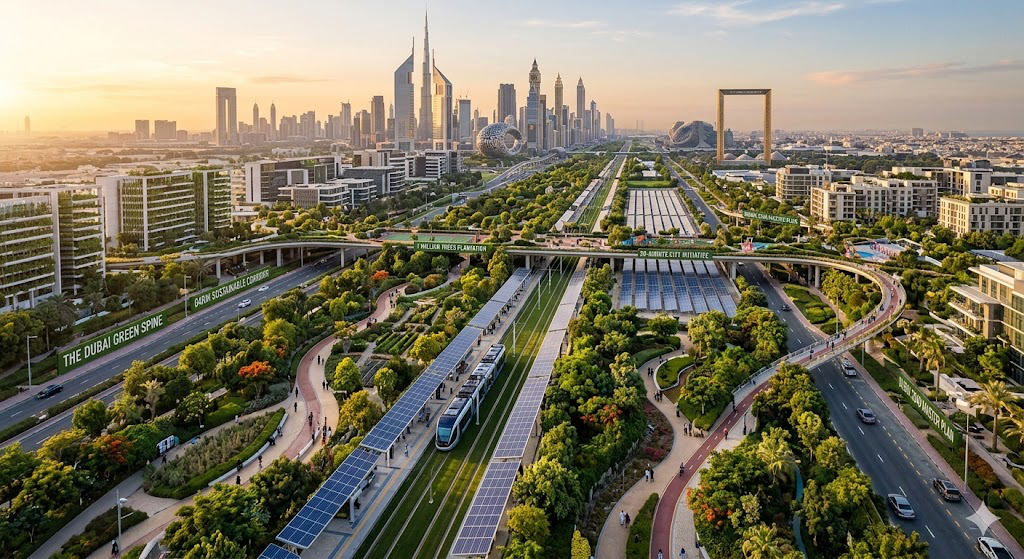
Transforming the busiest street within the metropolis, the Dubai Green Spine represents an ambitious initiative to transform Sheikh Mohammed bin Zayed Road (E311) into the largest sustainable urban hall in the world.
- Solar Power Centre: This backbone is engineered to provide three hundred megawatts of solar power, helping Dubai achieve its affordable energy goals.
- Urban Cooling: By planting more than 1,000,000 trees, the Mission seeks to lower ambient temperatures and furnish better air to nearby neighborhoods.
- Smart transit: The hall will include a fully electric powered tram machine and some paths for non-motorised transport which include cycling and walking.
Dubai Reefs: The world's largest ocean restoration
Transitioning from terrestrial to aquatic environments, Dubai Reefs embodies an innovative approach to marine protection and coastal habitat, extending over 2 hundred rectangular kilometres
- Floating Life Labs: This initiative gives sustainable floating residential systems and studies facilities that operate on renewable energy resources.
- Massive Afforestation: The mission aspires to cultivate 1,000 coral trees and 100,000 mangroves, which act as an important carbon sink for the place.
- Ecotourism: In addition to conservation efforts, it is going to provide specific ecotourism opportunities that emphasize environmental schooling as opposed to traditional industrial activities.
Al Maktoum International (DWC): Gateway to the World
Dubai is progressing closer to becoming the largest airport globally. The AED 128 billion increase in Al Maktoum International Airport is an essential detail of the Dubai South Vision.
- Five parallel runways: The final design works with five huge runways and four hundred airport gates, making it 5 times larger than the existing Dubai International (DXB).
- 260 million passengers: The airport is being built to deal with outstanding annual capacity, eventually established as the main hub for Emirates Airlines.
- Integrated Logistics: This initiative works because it is the cornerstone of a comprehensive multimodal shipping and logistics free zone.
Dubai Islands (formerly Deira Islands)
The newly branded Dubai Islands Challenge, managed through Nakheel, is reaching foundational milestones in 2026, substantially transforming the northern coastline
- Five Artificial Islands: This 17 square kilometer initiative introduces over 20 kilometers of newest beaches in the metropolis.
- Distinctive themes: Each of the 5 islands is composed of a unique theme, including luxury retail, top rate health, as well as sporting activities and recreational facilities
- Bridges and water taxis: An improved network of bridges and water taxi services will provide easy connectivity between the islands and the mainland
Conclusion: A progressive forward-thinking metropolis
These characteristics represent a critical tradeoff in Dubai's urban planning, steering us closer to a more sustainable, technologically advanced and oriented environment.
For a deeper insight into how these initiatives are "dazzling the world" please take a look into our previous blog.


.avif)
.avif)
.avif)
.avif)
.avif)
.avif)
.avif)
.avif)
.avif)
.avif)
.avif)
.avif)

.avif)
.avif)
.avif)
.avif)

.avif)
.avif)